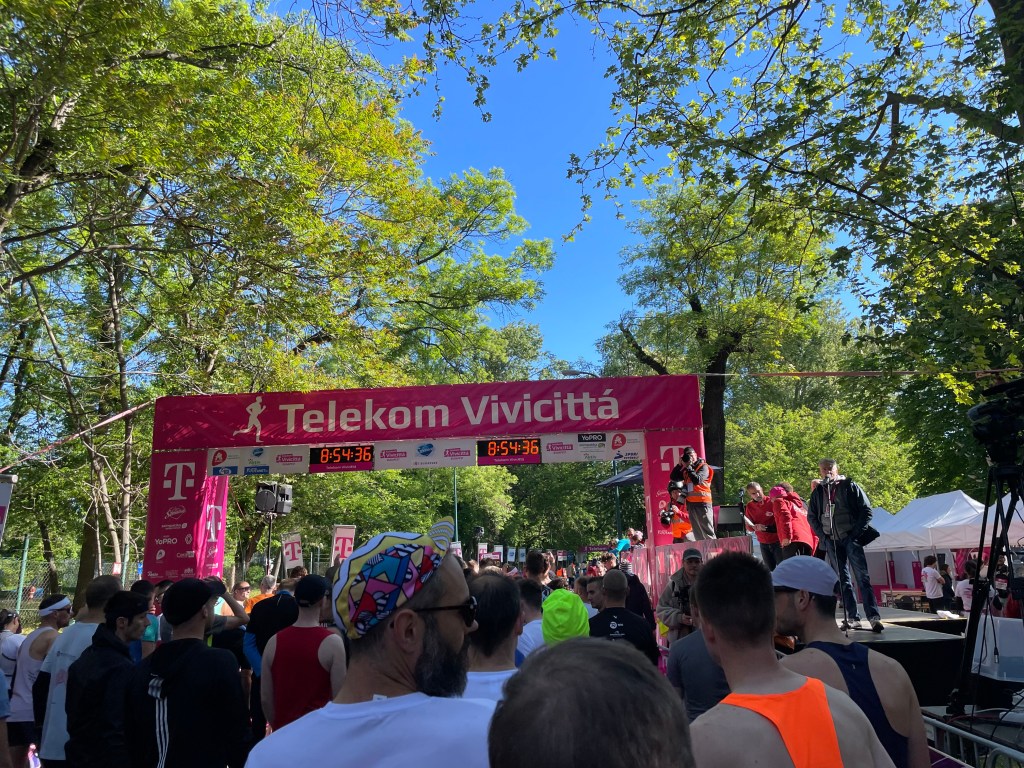
The Budapest Spring Marathon in 2024 started promptly at 9 a.m. There weren’t many people, the roads were wide, and the weather was quite comfortable. I thought I would achieve a better result than the result at the Berlin Marathon, but reality proved otherwise. Anyway, it’s important to have dreams, even though reality often hits like a wall.
I’ve been tormented by a leg injury from two weeks ago. Even during the warm-up just before the start, I felt the pain but pretended not to notice, trying to get excited and pumped up!
There was no hesitation; finishing a half marathon is simple for me, even with an injury. I ran 10 kilometers in a relaxed training session with a friend and felt comfortable after the injury, so I thought I could manage the race by just gritting my teeth and finishing, without worrying about the time.
I thought but I was not satisfied and still wanted to perform well on this flat course.
So, I started with the pacer for a finish time 1h30 , which was my target when I signed up. Though it was now unattainable, what if? People always fantasize about miracles, even though they rarely happen.
The biggest issue for humans is not being able to let go of obsessions. Like me, pursuing a goal I know is unachievable—kind of silly, right? To many non-runners, I probably seem like that kind of person.
Starting not far from the Margit Island Water Tower, passing the Musical Fountain to the bridge, turning right and then off the bridge along the Danube River, the first 7 kilometers were quite comfortable, mostly flat with a slight downhill, passing the Hungarian Parliament on the left and the Chain Bridge on the right, up to the vicinity of Corvinus University of Budapest and then turning back at Liberty Bridge, and then turning left up to the Natural History Museum. It was during this turnaround that my pain began, seeing the pacer about 10 meters ahead, but I could no longer keep up, having already run 9 kilometers.
During these first 9 kilometers, I was happy and relaxed, despite noticing a high heart rate on my watch, but I could still talk normally with people next to me. I admired a few high school boys who ran ahead of me with graceful strides, feeling a bit envious of their youth.
Throughout the race, I didn’t hydrate or eat, just kept running forward, occasionally looking down at my heart rate and pace. The real-time pacing on my Garmin watch seemed inaccurate, sometimes confusing me. As I approached the Liberty Bridge, there was a bit of an uphill, and I started to feel the strain. My pace dropped slightly, but it was easier going down the bridge, so I managed to keep up with the pacer for a while.
However, I was happy too earlier . There was the turnaround about one kilometer after the bridge, as mentioned before, and I felt a new pain or perhaps the aggravation of an old injury. My left foot became less responsive, making it hard to maintain my stride. I realized the issue but keeping the correct stride was challenging. I deliberately leaned forward, chest out, trying to feel the power of pushing off the ground, but every time my left foot hit the ground, I couldn’t exert much force, forcing me to reconsider my expectations.
Running with a calf injury meant a deformed running posture, extra strain on other lower limb parts, and a skyrocketing heart rate. I felt all these during the past week’s training, but since I was here, I pushed myself, determined not to leave with regrets.
After the 9-kilometer turnaround, the road ahead was still decent, along the Danube River, with no immediate uphills, but I couldn’t increase my speed, maintaining around 4:25, fluctuating slightly. After 12 kilometers, running towards the Buda Castle below, then from the riverside behind the castle, there was a slight uphill, and I felt very strained, similar to the 17-kilometer uphill at the Oslo Half Marathon, my steps slowed, each push off the ground felt uncomfortable, both painful and tiring, sometimes forcing me to change posture and take smaller, quicker steps, though not much faster. It was an uncomfortable feeling of wanting to speed up but being unable to.
I knew a 21-kilometer running wasn’t hard for me; at 15 kilometers, this belief kept me going, even though my pace had dropped to 4:40. I knew I wouldn’t make 1h30 or 1h32, but maybe 1h34 or 1h36 was possible, even if the last 5 minutes of pacing were slow.
Far ahead, I could see the Árpád Bridge leading to Margaret Island, my goal ahead. I was only at 15 kilometers, but the last 6 kilometers were within reach. I kept telling myself this, the bridge getting closer, and after climbing the bridge, it would be easier to speed up downhill. I kept encouraging myself, more tired than in pain by then. I saw different people overtaking me, including one I had passed earlier who seemed to be pushing hard but also very tired. I still cheered him on, and a young girl who had been behind me at the start managed to catch up after 16 kilometers, but I could no longer keep up with her.
At the last water station at 19 kilometers, I didn’t want to waste any time or stop, just wanted to keep running to the finish. In the last two kilometers, people started to speed up, but I couldn’t; I just maintained my current pace. The staff on the side shouted out my name, although they got it wrong, the atmosphere was encouraging, and I joined in shouting my name, and they shouted along with me.
Finally, I reached the bridge, turned around up the bridge, and pushed forward without any confusion. I wanted to speed up, but somehow, I didn’t feel like it. Why sprint? Just keep the pace steady to the finish. That’s what I did, heading steadily to the finish line. I heard them shout, “Perry Yang, China!” and then “Norway! Norway!” It seems many Norwegians visit Budapest this time of year.
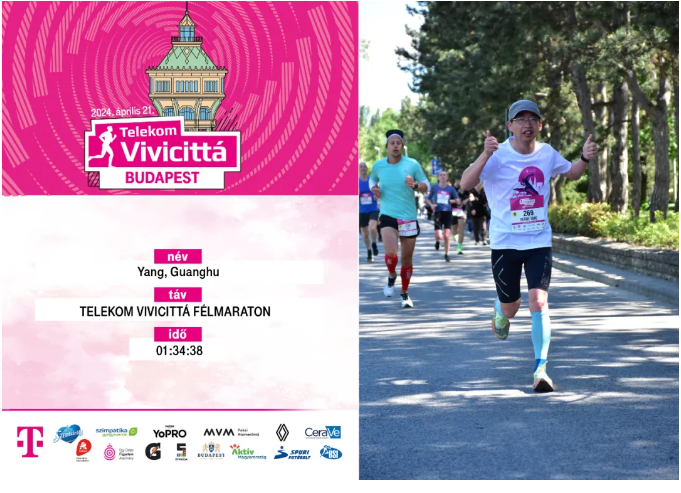
In the end, I completed the easiest yet personally challenging half marathon smoothly, with an official time of 1:34:38, without regrets.
Perry
2024.06.08
 SunnyInNorway
Leave a comment