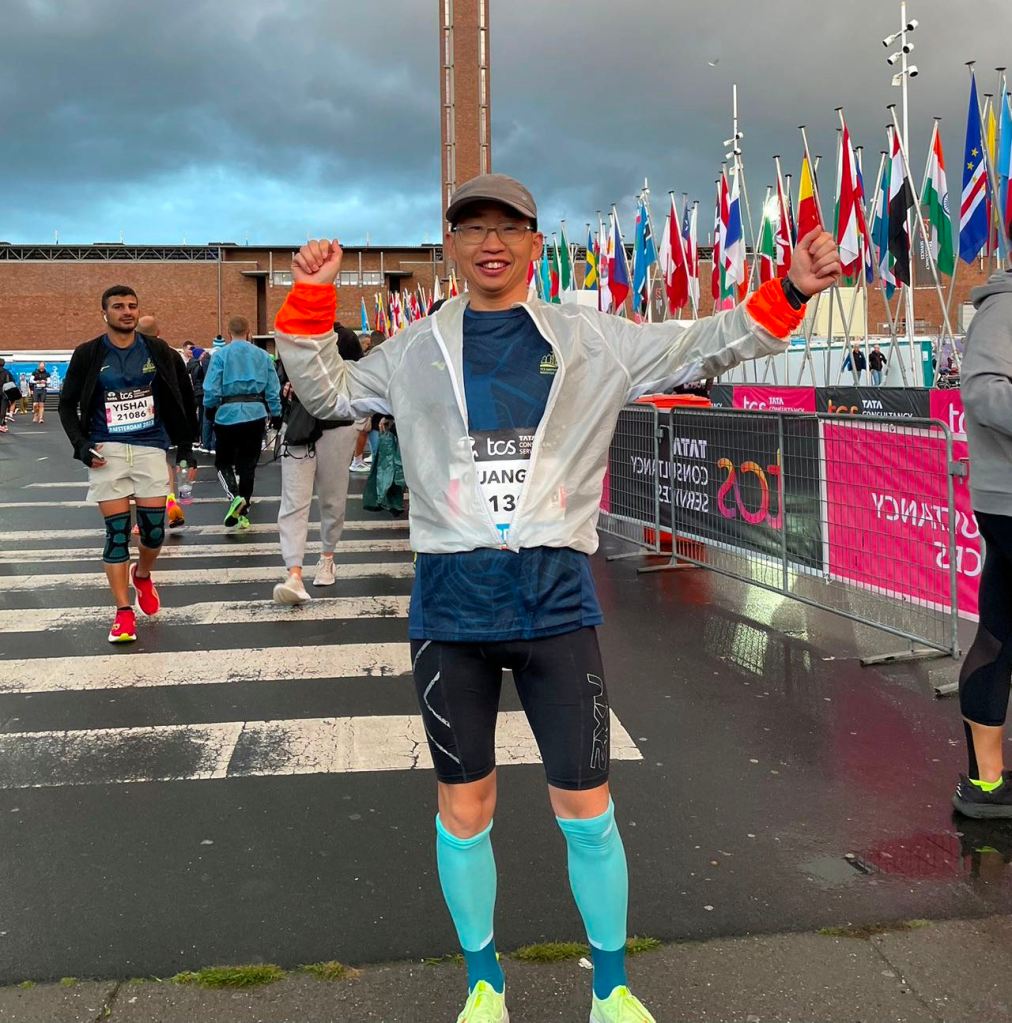
“Without any suspense, my performance in the Amsterdam Marathon was identical to the mid-September Oslo Marathon. After 32 kilometers, my speed began to drop, a common occurrence in the marathon world known as ‘hitting the wall.’
Oslo served as a warm-up race, and the plan was to run the entire course at a pace of 4 minutes and 45 seconds per kilometer. However, I couldn’t control my speed during the first half, and I ran 5 seconds faster, causing my pace to drop to 5 minutes and 30 seconds per kilometer after 32 kilometers. In the much-anticipated Amsterdam Marathon, I employed the same strategy as Oslo – starting fast and slowing down later. So, I accepted the inevitable result of hitting the wall with equanimity.
To achieve my goal of comfortably breaking 3 hours and 20 minutes and aiming for 3 hours and 15 minutes, I sought advice from an experienced runner friend who had participated in the Amsterdam race. He said, ‘Maintain a steady pace and follow the pacemaker. The Amsterdam course lacks enthusiastic crowds for a long stretch around the 30-kilometer mark, and it starts to incline. This part is crucial.’
His advice was sensible, but reality can be harsh. Half an hour before the starting gun, a heavy rain shower dampened the earlier excitement. When the rain subsided, I joined the crowd waiting to start, searching for the 3:20 pacemaker. However, I felt some reluctance and doubted my ability to maintain an even pace in the second half. I made a spontaneous decision to employ the start-fast, slow-down-later strategy. With this in mind, my body continued to move forward as I looked for the 3:15 pacemaker.”
“The greater the hope, the more fragile the psyche becomes. I really wanted to achieve my best performance in the Amsterdam Marathon, but the fact that the weather was rainy made me doubt my abilities. In my entire marathon training plan for 2023, I had only run a long-distance of 32 kilometers once, and long-distance endurance training is a necessary condition for successfully completing a full marathon. Compared to my preparations for the 2022 Berlin Marathon, I had run at least six times over 34 kilometers or more during the weekends.
Confidence is related to the regularity of training. If you haven’t put in the effort on a regular basis, aiming for a good result in a full marathon is nothing short of a dream. Nevertheless, I had just completed the Oslo Marathon, and I had confidence in being able to finish. The issue was pacing.
So, before the start, considering my training, I thought that employing a start-fast, slow-down-later strategy might be more suitable to achieve a better result. Therefore, I attempted to closely follow the 3:15 pacemaker. However, after 30 kilometers, my leg strength was significantly worse than in the first half, and I started to slow down. The pacemaker was pulling ahead, as their pace was 4:29, much faster than my usual marathon pace. Nevertheless, my heart rate remained good throughout the entire marathon, staying below 160, and never breaking the anaerobic threshold. Was it due to the weather or nutrition? I was still perplexed.
Everything went as expected, so the result was somewhat satisfactory: 3 hours, 17 minutes, and 56 seconds – my best time in four full marathons.
- Athens 2018: 4 hours, 5 minutes, 37 seconds
- Berlin 2022: 3 hours, 22 minutes, 27 seconds
- Oslo 2023: 3 hours, 31 minutes, 13 seconds
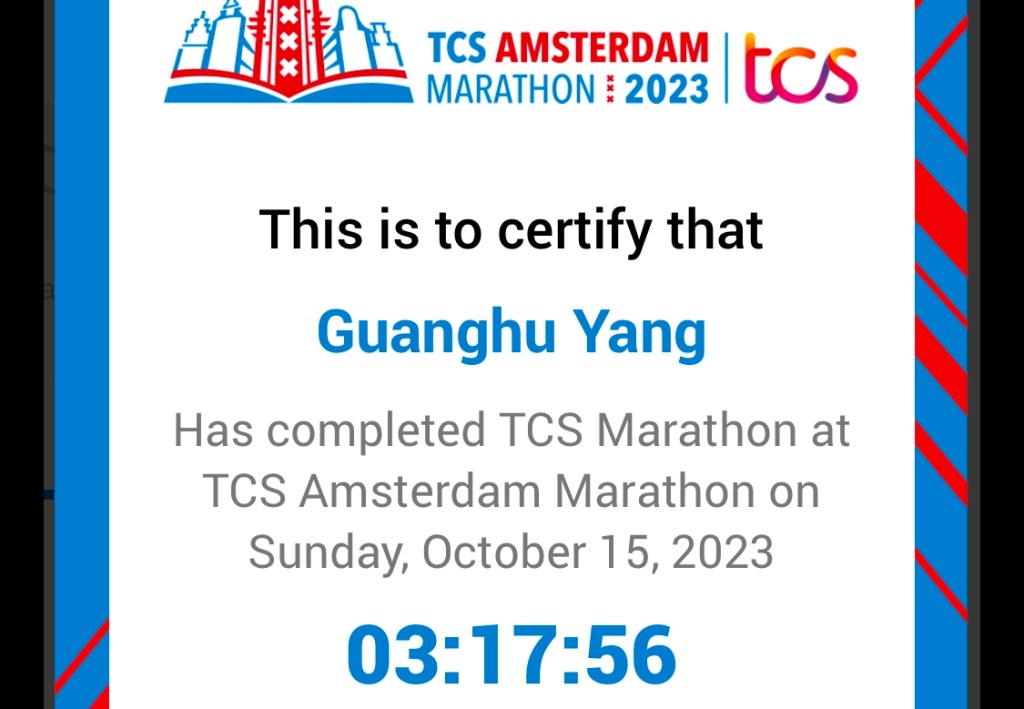
The Amsterdam Marathon is usually held on the second Sunday of October each year. After participating in the Berlin Marathon in 2022, I had the intention of joining another major marathon. I especially wanted to participate in the six World Marathon Majors, but except for the London Marathon, the others were not in Europe, and the long-distance travel was a significant concern. Eventually, I decided on the marathon for 2023 after completing the Berlin Half Marathon earlier this year.
Due to late registration, I could only sign up for the outer race. This was a rare Platinum Label race, which gave me a clear goal, and I scheduled my training plan accordingly. The race was set for October 15, 2023. I traveled alone, so I booked a flight on Saturday morning, which was relatively cheaper but still cost over 2000 NOK. From Amsterdam International Airport, you can take a direct train or subway to the Zuid area, which takes less than 20 minutes. It’s advisable not to take the airport bus, as my experience with the bus was not great; it was crowded and much more expensive compared to the subway or train.
Race bib collection took place in a sports center in the Zuid area, and the starting point was at the Olympic Stadium, located just across a river. This was much more convenient than Berlin. After collecting my bib, I could explore the race course and take some pictures.
So, I booked a hotel in the Zuid area, about 3 kilometers from the sports center, which I planned to use as my warm-up training run on the race day. However, accommodation prices in Amsterdam city center are quite high, whether it’s an Airbnb or a hotel. If I were to come again, I think I could consider booking accommodation near the airport, which is relatively cheaper, and it’s convenient for both the city center and the race venue, as well as the Chinatown.
After collecting my bib, I strolled around the Olympic Stadium, and then headed to the hotel to drop off my luggage. I wanted to check in early, but the hotel would charge 50 euros for early check-in, which I found quite expensive. So, I had to carry my suitcase to Chinatown.”
“China Town remained the same, and the images from ten years ago resurfaced, especially when I saw the roast duck at the Rongji restaurant. I couldn’t help but walk in, seeing the Chinese menu, and my mouth watered. However, the race was just a day away, so I had to satisfy myself with a light meal, mainly to replenish carbohydrates.
After the meal, I strolled through China Town on my own, visited Chinese supermarkets, went to the Dongfang Market, and also visited Zhengrong Grocery Store. Especially when I saw several Sichuan restaurants, I felt elated, knowing that there was a post-race feast to look forward to!
Pre-race nutrition is essential, and so is sleep. After arriving at the hotel, I took a short nap and then went to the front desk to inquire about the two most important pre- and post-race issues: (1) Breakfast time and (2) Shower after check-out. After receiving satisfactory answers, I visited the hotel’s fitness center. While the front desk did not allow a late check-out for post-race showers, they could provide a temporary access card to the gym’s shower facilities.
The final 30 minutes of my pre-race training plan were scheduled for the evening of today in Beatrixpark, Amsterdam. The run felt average with a pace of 5 minutes and 30 seconds per kilometer. I didn’t feel tired, but my heart rate was on the higher side.
Beatrixpark was not far from a famous Japanese restaurant. Since I didn’t have any specific requirements, I opted for convenience and didn’t visit China Town again. Instead, I had a beef salad at this Japanese restaurant for dinner. Since I hadn’t made a reservation, I could only find a place at the long table in front of the bar, with a limited time of one hour.
Reflecting on hitting the wall after 32 kilometers the next day, it might have been related to my dinner that evening. I didn’t eat enough or replenish more carbohydrates. If I had eaten more rice and noodles, it might have been better.
The next day, I woke up at 6:30 AM as planned and arrived at the restaurant by 6:50 AM. The restaurant manager said that it was the marathon day and, even though it was a few minutes before the dining time, they decided to open early. It was just a few minutes, but it showed the manager’s thoughtfulness.
I ran 3 kilometers to the race venue, taking 17 minutes, so I was essentially warmed up upon arrival. I didn’t do an extended warm-up since I saw a sea of runners arriving, even though the weather was not as bright, the sky not as blue (in reality, it was overcast). However, there was still some excitement in my heart.
The race started at 9 AM, and I didn’t expect that at 8:30 AM, there would be a sudden downpour with heavy rain and hail. My warm-up, which had just begun for a minute, had to be abruptly halted, and everyone sought shelter under the eaves of buildings.
The heavy rain lasted about 15 minutes, followed by a drizzle. By this time, everyone was queuing up, waiting for the race to start. I had originally been in the 3:15-3:30 pacing area, following the 3:20 pacer, but due to the weather, my confidence was affected, and I unconsciously crossed the pacing area barrier to search for the 3:15 pacer.
After the race started, the outer area’s two parallel starting lanes converged at about one kilometer, merging with participants coming from the stadium. Due to the rain, the early part of the course was relatively narrow, and it took a while for everyone to pass through. When I started running, I couldn’t see the 3:15 pacer anymore, even after one kilometer. I could only follow the crowd according to my own pace.
However, after some distance, I still couldn’t see the pacer. Even after more than three kilometers, I hadn’t seen the pacer who had started from the stadium. I figured it was best not to rely on the pacer, and I should proceed according to my pre-planned pace. It was only after more than three kilometers that I spotted a pacer in the distance, presumably the 3:15 pacer. I finally settled down and started following them from a distance.”
“About two kilometers into the race, I found myself in a park, and to exit the park, I had to pass through a small gate, which significantly affected my speed due to the crowd.
By the time I had caught up with the pacer, it was around 4 or 5 kilometers into the race, and I realized that the 3:15 pacer I thought I was following was actually the 3:10 pacer. No wonder I was wondering why I was chasing for so long at a 4:30 pace. Later, I thought, ‘Well, since I’m already here, I might as well stick with this pacer and run along with them.’ Perhaps it was this mentality that ultimately led to my marathon falling apart in the second half.
After passing the 13-kilometer mark, I ran along the canal, which was indeed a novel experience. Cheering crowds sailed in small boats on the canal, singing loudly. Some people were on speedboats playing loud music, and others were engaged in water sports and aerial photography. This continued until the 19-kilometer mark when we turned back from the canal bridge. At this point, I still felt quite comfortable, both physically and mentally. My heart rate was good as well. Unfortunately, there was light rain, and my hands began to feel cold. I pulled down the sleeves of my long-sleeved running shirt and continued to run with the 3:10 pacer.
By the time we had passed 19 kilometers, 21 kilometers, and 25 kilometers, I was still with the pacer. However, when we neared the 31-kilometer aid station, I had to stop to drink water. As I did this, I watched the pacer run further into the distance, and from that moment on, I lost the pacer and never caught up again.
After 30 kilometers, I began to feel the weakness in my lower legs. So, at the 31-kilometer aid station, I not only drank water but also had a banana. The next energy gel was planned at 38 kilometers, with one every 10 kilometers. In hindsight, I should have had another energy gel around 34 kilometers. It’s possible that my nutrition strategy wasn’t ideal.
After passing 37 kilometers, for runners who have completed marathons before, the final five kilometers shouldn’t be a problem, and you can finish. I felt a sense of determination and confidence within me, but my legs felt heavy, and I couldn’t pick up the pace. My heart rate was fine.
I remember passing the 40-kilometer aid station, and there was a Chinese volunteer calling my name and cheering for me. Suddenly, my head, which had been drooping, lifted up again, and I steadily ran towards the finish line at the Olympic Stadium.
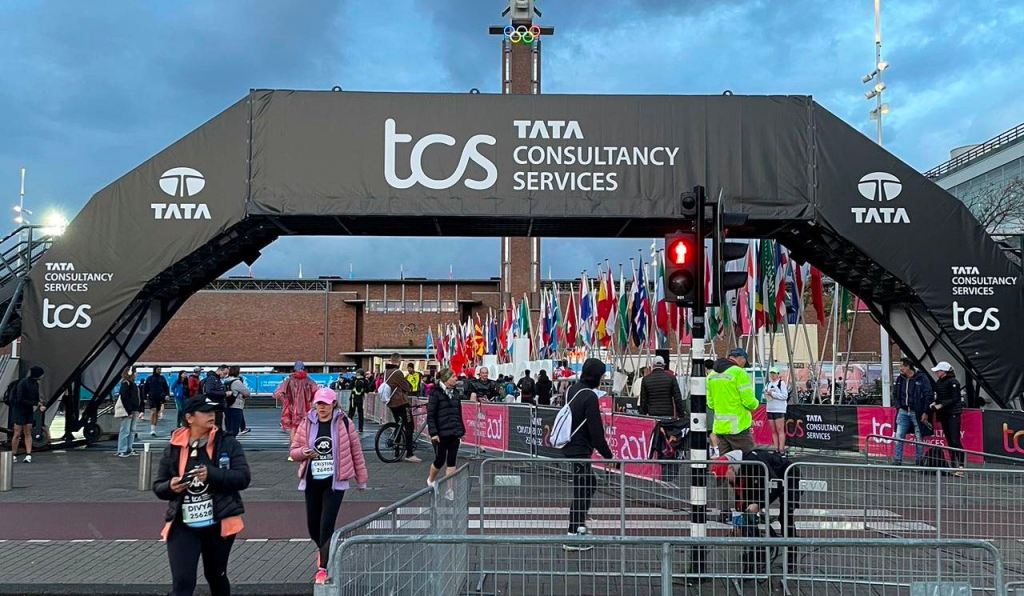
The feeling of achieving a personal best (PB) was genuinely great, but the experience of hitting the wall happened once again. Summarizing and reflecting on the race is necessary for learning and growth.
The PB isn’t the most important thing; it’s more about overcoming oneself. We should strive to defeat ourselves, which is the essence of competitive sports and the attitude needed when seeking improvement in any aspect of life. We aim for success not to be better than others but to become a better version of ourselves.
In conclusion, I’d like to end with the words of the great marathoner Eliud Kipchoge, which serve as a reflection of this marathon experience and an inspiration for all of us: ‘Only the disciplined ones are free in life. If you aren’t disciplined, you are a slave to your moods. You are a slave to your passions.’ – Eliud Kipchoge”
 SunnyInNorway
Leave a comment